Technical specifications
| Meter specifications | |
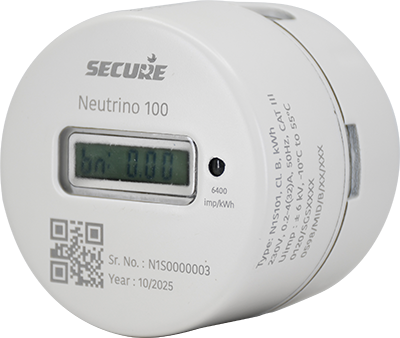
| Connection type | Direct-connected, thread through |
| Meter type | Single-phase, two-wire (single-element meter) |
| Rated voltage | 230 V (L–N), ± 20% |
| Current range | 0.2 -4(32) A |
| Frequency | 50 Hz ±5%, 60 Hz ±5% |
| Accuracy class | Class 1.0 / Class B |
| Utilisation category | UC1 |
| Power consumption | < 0.05 VA |
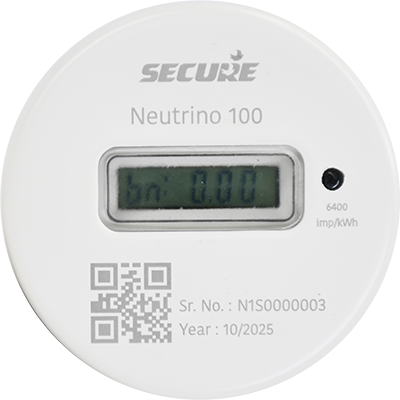
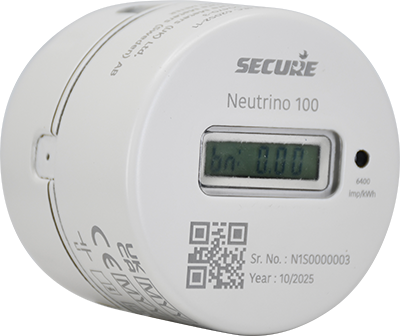
| Pulse | Active LED (6400 pulse/kWh) |
| Energy registers | +A (Active import) / -A (Active export) Separate register with compensated line losses Charging session-wise energy value Historical values / profile data |
| Compliance | |
| Standards | IEC 62052-11:2020, IEC 62053-21, IEC 62052-31 MID and MIR compliant with EN IEC 62052-11 and EN 50470-3:2021 |
| Data interface | |
| Serial communication type | RS-485 (bi-directional) |
| Protocol | Modbus RTU |
| Baud rate | 9600 to 115,200 |
| Mechanical | |
| Dimensions | Cylindrical: Diameter 61.5 mm x Height 50.5 mm |
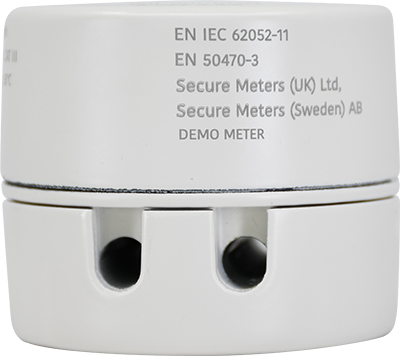
| Terminal diameter | 7.2 mm suitable for 2.5 to 6 mm² cables |
| Enclosure | Polycarbonate, halogen-free, recyclable |
| Weight | 300 g (approx) |
| Mechanical class | M2 according to MID Directive |
| Environmental | |
| Ingress protection | IP 30 |
| Temperature | -10 °C to +55 °C (operating), -25 °C to +70 °C (storage) |
| Humidity | 95% RH non-condensing |
| Altitude | Up to 2000 m |
| Safety and EMC characteristics | |
| Over voltage category | OVC III (as per IEC / EN 62052-31) |
| Rated peak impulse voltage | 6 kV (as per IEC / EN 62052-31) |
| Resistance to HF fields | 10 V/m (Under load) |
| Electromagnetic environment | E1 category |
| Functionality | |
| Application features | Ad-hoc charging session (kWh / session) Energy consumption for revenue settlement purposes Separate energy registers for cable loss compensation Instantaneous values (Active power, cumulative energy (total), voltage, current, PF, frequency) |